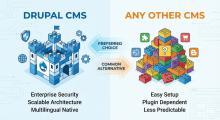
When discussing Content Management Systems (CMS), most people's minds automatically go to WordPress. However, in the world of large, complex, and demanding digital projects, Drupal (especially its modern versions, 10 and 11) dominates as a platform with unique capabilities.
Drupal isn't just "another CMS." It is often described as a Content Management Framework (CMF), meaning it's a hybrid between a CMS and a programming framework (like Symfony, which it is now built on). This fundamental difference is the source of its power.
Let's look at why Drupal 10/11 isn't just an alternative, but a strategic choice for specific purposes.
1. Enterprise-Grade Security
This is the area where Drupal is the undisputed leader.
- Security Architecture: Drupal was designed from the ground up with security in mind. It has built-in protection mechanisms against common threats (like SQL injection, XSS) that other platforms often require extra plugins to handle.
- Dedicated Security Team: It has a dedicated, global security team that audits the core and contributed modules, issuing regular security advisories.
- The "Social Proof": It's no coincidence that Drupal powers some of the most critical websites on the planet, including government organizations (like the White House), major universities, and global enterprises.
In contrast, platforms like WordPress, due to their immense popularity and chaotic ecosystem of thousands of plugins of varying quality, are a much more frequent target and are inherently more vulnerable if not meticulously maintained.
2. Flexibility in Content Structure
This is where the "magic" of Drupal lies. WordPress is excellent at managing "Posts" and "Pages." Drupal, on the other hand, makes no assumptions about what kind of content you want.
- Content Types and Fields: In Drupal, you can define your own "Content Types." Want to build a movie catalog? You create a "Movie" content type with "Fields" like "Director," "Release Date," "Rating," and "Poster."
- Views: This is Drupal's secret weapon. The "Views" module (now built into the core) is a powerful graphical query-building tool. It allows you to fetch any content from the database and display it in any way (list, grid, table, map) in any part of the site, without writing a single line of code.
Other CMSs try to achieve this with plugins, but none match the native power and flexibility of Drupal's "Entities - Fields - Views" system.
3. Performance and Scalability
Drupal is engineered to handle massive traffic loads.
- Advanced Caching: Drupal's core features sophisticated caching layers (BigPipe, Dynamic Page Cache) that allow it to serve pages incredibly fast, even to logged-in users.
- Database Optimization: Its architecture is built to manage millions of entries (nodes) without the database "kneeling."
While WordPress can be made fast with expensive hosting plans and specialized caching plugins, Drupal is built for high performance from the ground up.
4. API-First and Headless CMS
The modern versions of Drupal (10 and 11) are built with an "API-First" philosophy. This means it is extremely easy to use as a Headless (or Decoupled) CMS.
What does this mean? You can use Drupal as a powerful backend to manage all your content and "serve" that content (via its built-in JSON:API) to anything:
A modern front-end application (React, Vue, Svelte).
A mobile app (iOS/Android).
IoT devices.
Anything that can consume an API.
This capability makes it ideal for modern, omnichannel digital experiences, something most traditional CMSs struggle to do.
5. Accessibility
Drupal has a strong, long-standing commitment to accessibility (WCAG standards). Many accessibility features are built into the core, both for the end-user and for the administrator working in the backend. This is critical for government and educational institutions.
Conclusion: Not for Everyone, but Unbeatable Where it Matters
To be fair, Drupal has a steeper learning curve than WordPress. It is not the platform someone would choose to build a simple personal blog in an afternoon.
Drupal 10/11 stands out because it is the choice for ambitious, structured, and long-term projects.
- You choose WordPress when your priority is ease of use, rapid implementation, and a vast ecosystem of ready-made solutions for simple websites and e-shops (with WooCommerce).
- You choose Drupal when your requirements involve:
- Non-negotiable security.
- Complex data architecture.
- Robust multilingual support (it's a leader in this).
- Managing thousands or millions of users and pages.
- The need for a Headless CMS and integration with multiple systems.
Simply put, other CMSs help you publish content, while Drupal helps you structure and control entire digital experiences.
Blog Recent